
Explore
This church is considered one of the most beautiful and largest historic churches among the monasteries of Wadi El Natrun. The earliest core of the church dates back to the 4th century AD. It was rebuilt during the 9th century, in the pontificate of Pope Benjamin II (830–849 AD), following the fifth Berber raid on the monastery. The northern sanctuary of the church dates from this reconstruction period. The church contains numerous architectural and artistic features from different historical eras. While the main sanctuary dates back to the 6th or 7th century, other elements—such as the elevated domes, stained glass windows, stucco decorations, and the architecture of the nave—were likely added during the 10th or 11th century. Additional modifications were made to the church buildings during the late 11th and early 12th centuries. In the 14th century (1330 AD), during the papacy of Pope Benjamin II, restoration work was carried out to repair wooden structures that had been damaged by termites. A special tomb for Pope Benjamin II is located in the southwestern section of the church, above which a modern wall painting depicting the Pope can be seen.
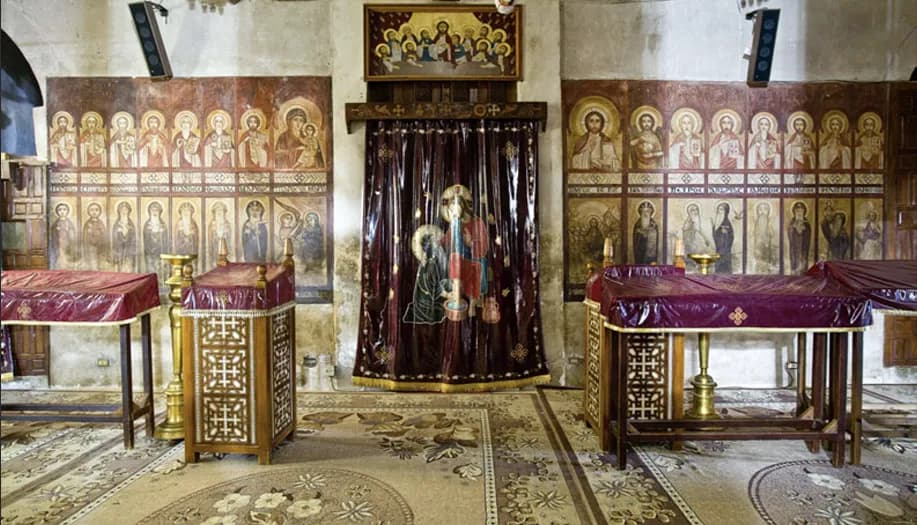
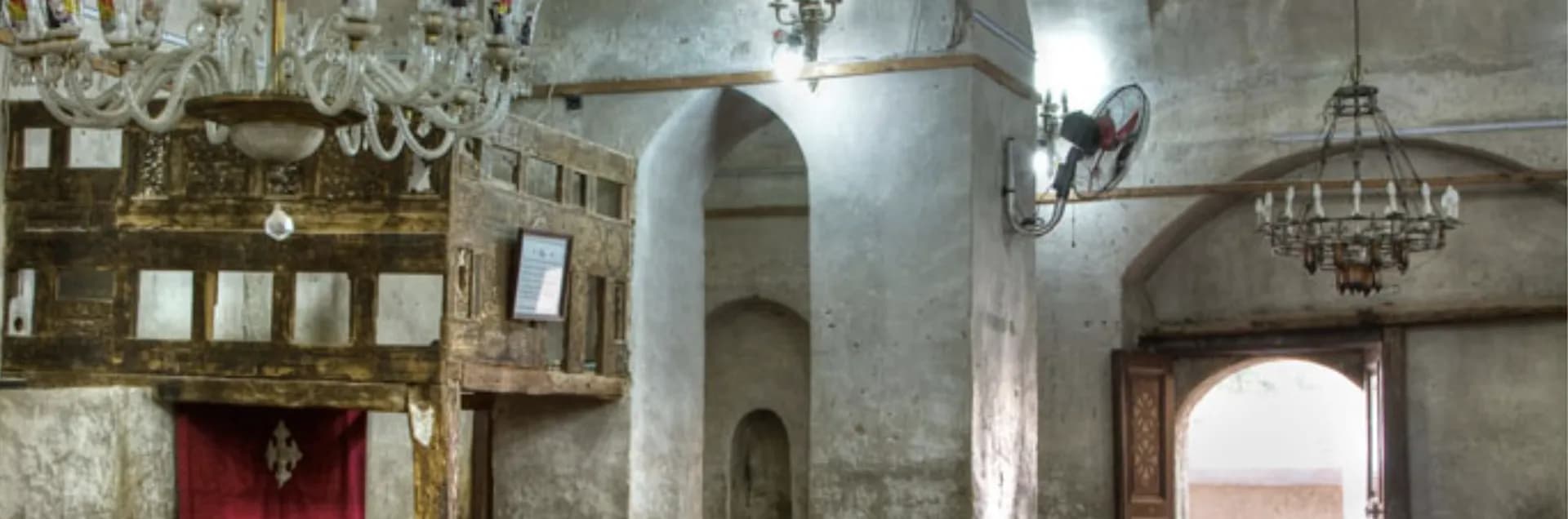
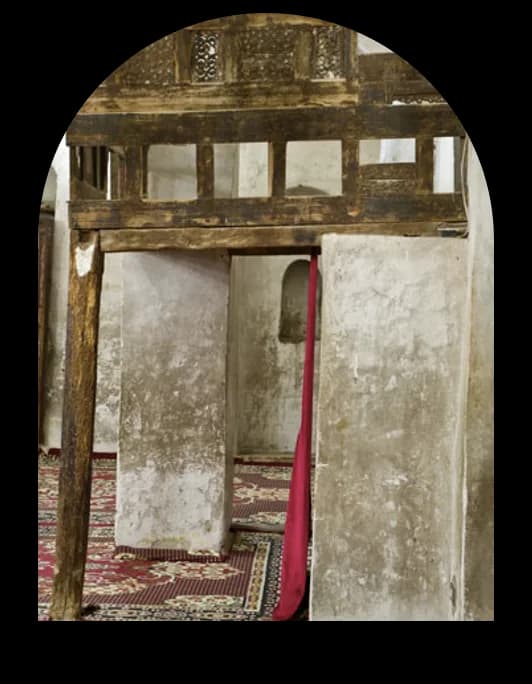
This church follows the Long Type style of churches, which corresponds in its main features to the basilican architectural style. It consists of a nave, two side aisles, a western circular aisle, a transverse choir, and three sanctuaries. Over time, the church evolved into an irregular quadrilateral structure through the addition of small chapels (sanctuaries) and annexes. In the late 11th or early 12th century, the Church of the martyr Abaskhiron El-Keliny was built on the southern side of this church, though on a different axis. Its northwestern corner touches the southern wall of the Church of Anba Bishoy, which dates back to the 9th century. The current baptistery may originally have occupied the location of the main and southern sanctuaries of this church. It should be noted that placing the ancient baptistery in this position was probably the proper liturgical arrangement for the Baptistery of the Church of Saint Mercurius (Abu Seifein), the Monks’ Church. However, this baptistery is no longer in use. More recently, a new baptistery was established in the northwestern section of the new cathedral during the time of the late Pope Shenouda III. The Church of Anba Bishoy has three entrances located on its northern, southern, and western sides. Entering through the western doorway leads into the nave, which is separated from the northern and southern aisles by stone piers. The nave and aisles are roofed with brick vaults that replaced the original wooden ceiling, while the sanctuaries are covered with domes. The nave is divided into two unequal sections, eastern and western, by a pair of massive piers supporting pointed arches. These arches did not originally exist in the church and most of them were blocked during the 18th century in order to reinforce the nave walls. The eastern section is known as the “Outer Choir” and is used during Holy Week when the original choir is closed during the first part of the rites. In the western section of the nave is the basin of the Laqqan service. There are also remains of a wooden ambo (pulpit) in the northwestern corner, serving as an adjunct or counterpart to another wooden ambo dating to the 14th century, which still stands in the eastern end of the nave. The existence of two ambos from the same period may be explained by the western one being reserved for use during the Maundy Thursday rites. The church’s three aisles (northern, southern, and western) date back to the 14th century. In the southern corner of the southern aisle lies the tomb of Pope Benjamin II. There are also two roofed entrances (doxars) on the northern and southern sides of the outer choir, dating to the 11th or 12th century. The northern doxar has a rectangular ground plan, while the southern one is square in design. The choir has three entrances: one from the nave, one from the northern aisle, and one from the southern aisle. The first entrance was blocked during the 14th-century restoration, leaving only a raised rectangular wooden door in its center, which still survives. The choir itself is covered by a dome independent from the domes of the nave and aisles. Two small chapels (sanctuaries) open onto the choir. The northern one is dedicated to Saint Mary the Virgin and is also known as the “Sanctuary of Pope Benjamin.” The southern one is smaller and dedicated to the martyr Abaskhiron El-Keliny. Against the eastern wall of the choir, north of the entrance to the main sanctuary, stands a recently made wooden reliquary containing the body of Saint Anba Bishoy and the relics of Saint Anba Paula El-Tamouhy. The central sanctuary has a square ground plan and its floor is raised one step above the choir floor. It dates back to the 9th century and has doorways in its northern and southern walls leading to the side sanctuaries. The sanctuary contains an altar dedicated to Anba Bishoy. In its eastern apse is a staircase of seven steps symbolizing the ranks of the priesthood. The sanctuary dome is hemispherical and made of red brick, dating to the 14th century, and supported by pendentives. The southern sanctuary contains an altar dedicated to Saint John the Baptist, covered with a marble slab. Although originally intended to have a square plan, the southern wall built adjacent to the baptistery forced the architect to adopt a compromise solution. The dome of this sanctuary is also hemispherical and rests on pendentives. This sanctuary dates to the 14th century and still preserves remnants of wall paintings. The northern sanctuary contains an altar dedicated to Saint Mary the Virgin. It is rectangular in shape, covered with a marble slab, and dates to the 9th century. Its roof is covered by a barrel vault ending at the eastern side with a small dome supported by pendentives. The sanctuary entrance is closed by a modern iconostasis whose doors date back to the 14th century. Inside is a rectangular altar covered with a marble slab in the “square-and-semicircle” style, along with recently discovered remnants of wall paintings.