
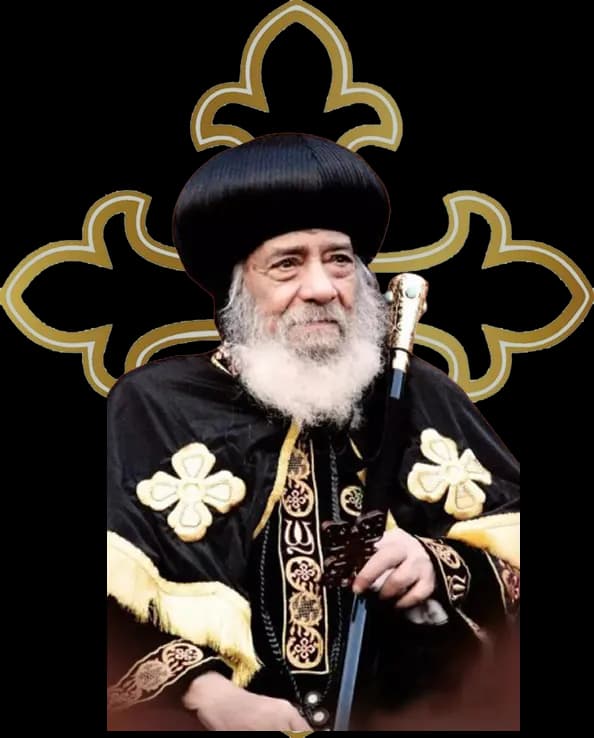
Pope Shenouda III
His Holiness Pope Shenouda III (the 117th Pope) was of blessed memory. He became a monk at the Monastery of the Syrians in Wadi El Natrun, taking the name Father Antonius the Syrian, and was chosen as Patriarch of the See of St. Mark in 1971. Pope Shenouda III passed away in 2012, and his life and teachings continue to be a source of inspiration and love for millions of Copts around the world.
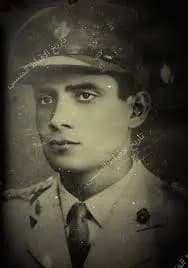
Pope Shenouda III was born on August 3, 1923, in the village of Salam, Assiut Governorate, Egypt. His birth name was Nazeer Gayed Roufail. He completed his early education in Damanhur, Alexandria, Assiut, and Benha, and finished his secondary education at Al-Iman Secondary School in Geziret Badran, Shubra, Cairo. In 1939, he began serving in the Sunday School movement at the Church of the Virgin Mary in Muharram Bey, Cairo. In 1946, he started serving at the Church of Saint Anthony in Shoubra, Cairo. In 1947, he earned a Bachelor of Arts degree in History from the Faculty of Arts at King Fouad I University (now Cairo University). In the same year, he graduated from the Reserve Officers College. He enrolled in the Coptic Orthodox Theological Seminary in 1946 and graduated in 1949. After graduation, he worked in the field of education and dedicated himself to church service and teaching at the Seminary. In October 1949, he became Editor-in-Chief of the Sunday Schools Magazine, a position he held until his monastic profession in July 1954. In 1952, he was appointed Chairman of the Board of the Sunday Schools House, but later resigned to devote himself fully to theological education and ministry. In 1953, he taught at the Monastic School in Helwan. On July 18, 1954, he entered monastic life at the Monastery of the Virgin Mary (Deir El-Surian) in Wadi El Natrun and was given the name Fr. Antonios El-Souriany (Antonious the Syrian Monk). He became the librarian of the monastery and began a life of solitude and asceticism in February 1956. He was ordained a priest on Sunday, August 31, 1958, by Anba Theophilus, then Bishop of the Monastery. In June 1959, Pope Cyril VI selected him to serve as his personal secretary. On September 30, 1962, he was consecrated Bishop of Christian Education under the name Anba Shenouda. He subsequently established spiritual meetings and educational gatherings for preaching and teaching in the area of St. Rewiss Monastery in Abbassia, Cairo.
In January 1965, Pope Shenouda III launched El-Keraza Magazine and became a member of the Egyptian Journalists Syndicate in 1966. Following the passing of Pope Cyril VI in 1971, he was chosen through the Altar Lottery and was enthroned on November 14, 1971, as the 117th Pope of Alexandria and Patriarch of the See of Saint Mark. Throughout his papacy, he played a leading role in both church and ecumenical affairs. He served as President of the World Council of Churches for the Oriental Orthodox Churches and later as President of the Middle East Council of Churches. He made more than 100 pastoral and ecumenical visits worldwide and ordained numerous bishops and priests. He also consecrated the Holy Myron seven times and brought the relics of Saint Athanasius the Apostolic back to Egypt in 1973. Pope Shenouda established several bishoprics, educational institutes, and cultural centers, including the Coptic Orthodox Cultural Center, while also supporting the expansion of church ministries in Egypt and abroad. During his papacy, several Coptic satellite channels were launched, helping to strengthen the Church’s outreach and educational mission. Known for his wisdom and patriotism, he supported national causes and guided the Church through significant challenges, including his period of exile at St. Bishoy Monastery between 1981 and 1985. He was also a prolific author, publishing around 150 books and numerous articles, sermons, and poems. Pope Shenouda III reposed on March 17, 2012, after serving on the Patriarchal Throne for more than 40 years. According to his wishes, he was buried at St. Bishoy Monastery in Wadi El Natrun. He is remembered as one of the most influential leaders in the modern history of the Coptic Orthodox Church, and for his well-known saying: “Egypt is not a country we live in; Egypt is a country that lives within us.”